In the late 1960s and early 1970s, a series of letters, symbols, and coded messages turned an already disturbing Northern California case into one of America’s most famous communication mysteries. The person who signed some of those messages as “Zodiac” did more than contact newspapers. He created a public puzzle that drew in police, reporters, cryptographers, and ordinary readers.
For many people, the most fascinating part of the case is not only the identity of the person behind the letters, but the meaning of the ciphers themselves. Some were solved. Others remain unresolved or heavily debated. The result is a historical mystery that sits at the border of crime history, media psychology, and cryptography.
This article focuses on the Zodiac letters and ciphers as historical documents: what is confirmed, what was decoded, what remains unsolved, and why the messages still attract attention more than half a century later.

- Key Takeaways
- Why the Zodiac Letters Still Matter
- Historical Background: The Case Behind the Communications
- Fact Versus Fiction in the Zodiac Letters
- The Z408 Cipher: The First Major Breakthrough
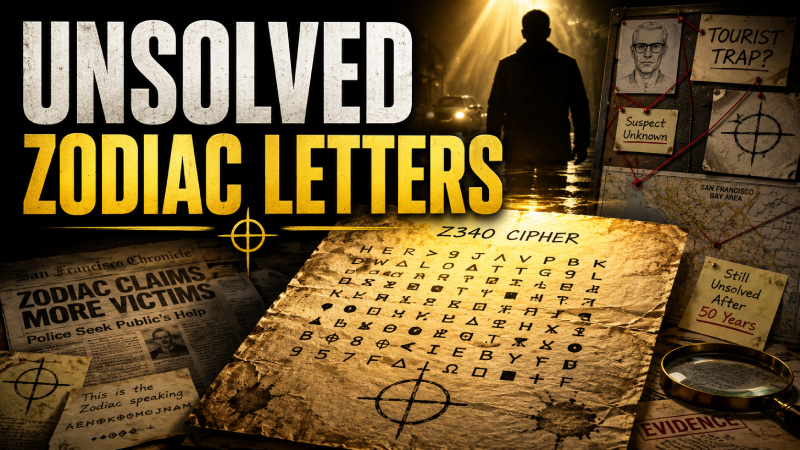
- The Z340 Cipher: A Mystery Solved After 51 Years
- How the Zodiac Ciphers Worked
- Unsolved Elements: Z13 and Z32
- Media, Fear, and the Public Puzzle
- What the Decoded Messages Actually Changed
- Why So Many False Solutions Appear
- The Cryptographic Legacy of the Zodiac Case
- What the Zodiac Letters Still Cannot Tell Us
- Conclusion
- FAQ
Key Takeaways
- The Zodiac case is still associated with uncertainty and debate.
- The letters and ciphers helped turn the case into a public media phenomenon.
- The Z408 cipher was solved quickly in 1969, while the Z340 cipher was solved in 2020.
- The shorter Z13 and Z32 ciphers remain unresolved in any officially accepted sense.
- Responsible analysis must separate confirmed cipher solutions from speculation.
Why the Zodiac Letters Still Matter
The Zodiac letters matter because they changed how the public experienced the case. They were not private notes found years later in an archive. They were sent to newspapers and law enforcement during a period of fear and media attention. Some contained symbols. Some contained claims. Some appeared to be designed to force publication and keep the sender at the center of public discussion.
That is why the letters are not merely background details. They became part of the event itself. Newspapers had to decide what to publish. Investigators had to decide which claims were credible. Amateur codebreakers tried to solve the ciphers. Readers followed the case almost as if it were unfolding through a disturbing series of public messages.
Even today, the letters continue to shape the way people understand the case. They raise questions not only about identity, but also about motive, performance, media manipulation, and the limits of interpretation.
Historical Background: The Case Behind the Communications
The Zodiac case is usually associated with Northern California in the late 1960s. The known and confirmed events are often discussed alongside the communications sent to newspapers in the San Francisco Bay Area. While the sender claimed responsibility for more deaths than authorities could verify, responsible summaries generally distinguish between confirmed victims, claimed victims, and speculation.
For an article about the letters, the precise timeline matters because the communications did not appear in isolation. They followed and responded to real events, media coverage, and public fear. The letters helped turn a regional investigation into a national mystery.
| Event | Date | Location | Why It Matters |
|---|---|---|---|
| Lake Herman Road attack | December 20, 1968 | Near Benicia, California | Often listed as the first confirmed Zodiac attack |
| Blue Rock Springs attack | July 4–5, 1969 | Vallejo, California | One victim died and one survived; communications followed soon after |
| Lake Berryessa attack | September 27, 1969 | Napa County, California | Associated with distinctive symbolism and later public attention |
| Paul Stine case | October 11, 1969 | San Francisco, California | Generally treated as the last confirmed Zodiac murder |

Fact Versus Fiction in the Zodiac Letters
One of the biggest problems with the Zodiac communications is that they sit inside a larger cloud of rumor, imitation, disputed documents, and later theories. Some letters are widely accepted as part of the case. Others have been debated. Some claims made in the letters cannot be accepted at face value.
This distinction matters. A letter can be historically important even if parts of it are misleading, exaggerated, or manipulative. The sender had a clear interest in controlling attention. That means the letters should be read carefully, not as neutral testimony.
For the same reason, online “solutions” to unsolved ciphers require caution. A proposed name hidden in a short code may look persuasive when the reader wants an answer, but cryptographic proof requires more than a dramatic pattern. It requires a reproducible method, consistent rules, and evidence that does not simply bend the symbols to fit a desired suspect.
The Z408 Cipher: The First Major Breakthrough
The first famous Zodiac cipher, commonly known as Z408 because it contained 408 characters, was solved in 1969 by Donald and Bettye Harden. The cipher used a homophonic substitution method, meaning that more than one symbol could represent the same plaintext letter. That made it harder than a simple substitution puzzle, but it was still solvable with careful pattern analysis.
The solution did not identify the sender by name. Instead, it revealed a message that reflected the threatening and theatrical nature of the communications. The importance of the Z408 was not that it solved the case. It proved that the cipher was not random decoration; it contained a deliberate message.
That first solution also helped create a lasting public fascination. If one cipher could be solved, perhaps the next one could reveal something more. That expectation shaped decades of interest in the remaining codes.

The Z340 Cipher: A Mystery Solved After 51 Years
The 340-character cipher, known as Z340, became one of the most famous unsolved ciphers in American crime history. It was mailed in November 1969 and resisted solution for decades. Many proposed answers appeared over the years, but none gained official acceptance until 2020.
In December 2020, a team including David Oranchak, Sam Blake, and Jarl Van Eycke announced a solution. Their approach relied on modern computational methods and a careful understanding of transposition. The FBI later confirmed that it had verified the solution. The decrypted message did not reveal the sender’s identity, but it did provide a clearer look at the tone and intent behind the communication.
The Z340 breakthrough is important because it shows how old mysteries can change when new tools become available. A code that resisted generations of manual analysis became solvable when computational power, persistence, and a correct structural insight came together.

How the Zodiac Ciphers Worked
The Zodiac ciphers combined substitution and, in the case of Z340, more complex arrangement. In simple terms, substitution changes letters into symbols. Homophonic substitution makes that harder by allowing multiple symbols to stand for the same letter. Transposition changes the reading order, so the message may not be read straight across the page.
This combination makes a cipher much more difficult to solve. A codebreaker may correctly identify some symbols, yet still fail if the reading direction is wrong. That appears to be part of what made the Z340 so difficult for so long.
| Cipher | Status | General Method | What It Did Not Do |
|---|---|---|---|
| Z408 | Solved in 1969 | Homophonic substitution | Did not reveal a confirmed identity |
| Z340 | Solved in 2020 | Substitution plus transposition | Did not name the sender |
| Z13 | Unsolved / debated | Too short for confident confirmation | No accepted identity solution |
| Z32 | Unsolved / debated | Possibly map-related, but unresolved | No accepted location solution |
Unsolved Elements: Z13 and Z32
The shorter Zodiac ciphers are among the most frustrating parts of the case. The Z13, introduced with a phrase suggesting a name, seems as though it should be important. But its length creates a serious problem: with only 13 symbols, many possible names or phrases can be forced into the structure.
The Z32 is also unresolved. It has often been discussed in relation to a map and possible geographic meaning, but no solution has been accepted as definitive. Like the Z13, it is short enough to invite many creative interpretations and too ambiguous to settle the question easily.
This is why responsible articles should be careful with claims about the Z13 or Z32. New proposed solutions appear from time to time, sometimes using computers or artificial intelligence, but an interesting proposal is not the same as verified proof.

Media, Fear, and the Public Puzzle
The Zodiac letters became famous partly because of how they interacted with the media. Newspapers received messages. Some ciphers were published. The public was invited, directly or indirectly, into the decoding process. That turned the case into something more than a police investigation; it became a public puzzle.
This media dynamic is one of the most unsettling features of the case. The sender appeared to understand that publicity could amplify fear. Each published symbol or letter gave the public something new to analyze, discuss, and fear.
At the same time, public attention also produced genuine contributions. The Hardens solved the Z408. Later civilian researchers helped solve the Z340. The case therefore shows both sides of publicity: it can reward manipulation, but it can also bring many minds to a difficult problem.

What the Decoded Messages Actually Changed
The decoded messages changed how the communications were understood, but they did not solve the identity question. This is an important distinction. A decoded cipher can reveal tone, themes, and intent without revealing a name.
The Z408 showed that the early cipher contained a deliberate message. The Z340 confirmed that the later cipher also had a coherent structure and could be solved by identifying the correct method. Neither cipher produced the kind of simple confession or signature that would close the case.
In that sense, the decoded messages deepened the mystery rather than ending it. They gave investigators and researchers more to study, but they also showed that the sender may have been more interested in attention and intimidation than in leaving a clean trail to his identity.
Why So Many False Solutions Appear
Zodiac cipher theories remain popular because the case offers just enough information to invite interpretation and just enough uncertainty to prevent closure. A person can take a short cipher, a suspect’s name, or a pattern of symbols and build a theory that feels convincing.
The problem is that many false solutions use flexible rules. They may change spelling, ignore inconvenient symbols, or treat coincidence as proof. This is especially risky with short ciphers, where many different answers can seem possible.
A strong solution should be repeatable, rule-based, and consistent with the structure of the cipher. It should not require the solver to decide after the fact which symbols count and which can be ignored.
The Cryptographic Legacy of the Zodiac Case
The Zodiac ciphers are now part of both crime history and cryptographic history. They show how classical code methods can still challenge people when combined with misdirection and unusual structure. They also show how modern computing can revisit old problems in new ways.
The Z340 solution is especially important because it was not simply a matter of guessing words. It required discovering a reading pattern and testing possibilities at a scale that earlier investigators could not easily manage. That makes the case a useful example of how technology changes the study of historical puzzles.
However, the cryptographic legacy should not be overstated. These ciphers are not modern cybersecurity systems. They are historical puzzles created in a specific context. Their value today is partly technical, partly cultural, and partly historical.
What the Zodiac Letters Still Cannot Tell Us
The letters cannot reliably tell us everything. They cannot be treated as honest autobiography. They cannot confirm every claim made by the sender. They cannot, by themselves, identify the person responsible. They are evidence, but they are also performance.
That is what makes them so difficult and so fascinating. They are both clues and masks. They reveal something about the sender’s desire for attention, but they may also conceal, distort, or exaggerate.
The strongest interpretation is therefore cautious: the letters help explain how the case became famous, how fear spread, and how ciphers became central to the mystery. They do not provide a final answer.
Conclusion
The unsolved Zodiac letters remain powerful because they combine mystery, media, and codebreaking in a way few cases ever have. The Z408 and Z340 show that some messages can be decoded even after years of uncertainty. The Z13 and Z32 show that some puzzles may remain beyond confident interpretation, especially when they are short, ambiguous, and surrounded by speculation.
The mystery of the Zodiac cipher is not simply about cracking symbols. It is about understanding how communication can become part of an investigation, how media can amplify fear, and how the search for meaning can continue long after the original events have passed.
More than half a century later, the letters still ask the same question: were they meant to reveal something, or were they designed to keep everyone searching? For now, the answer remains incomplete.