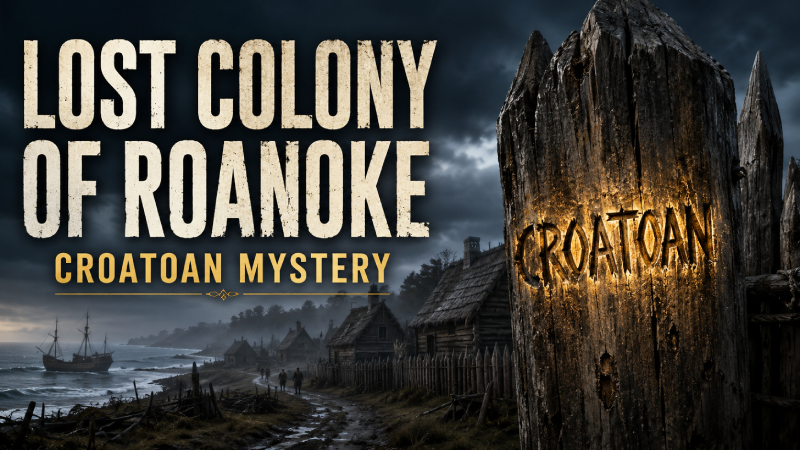
In the summer of 1590, explorer John White returned to Roanoke Island expecting to find the settlement he had left three years earlier thriving. Instead, he discovered an eerie scene: the colony was abandoned, its structures deliberately dismantled, and carved into a wooden post of the palisade was a single word$2014CROATOAN. This cryptic clue would become the central mystery of early American colonial history, one that continues to perplex historians and capture public imagination more than four centuries later.
What happened to the 117 men, women, and children who arrived at Roanoke Island in 1587 remains unknown. Did they perish from starvation, disease, or conflict with neighboring peoples? Did they manage to escape and integrate with local Native American communities? The evidence allows for multiple interpretations, and the truth$2014if history ever fully reveals it$2014may lie somewhere between these competing theories.
This article explores the historical context, key events, and prevailing theories surrounding this enigmatic settlement, examining both what we know and what remains frustratingly beyond our reach.

- Understanding the Historical Context
- Early English Expeditions: Reconnaissance and Hope
- The 1585 Military Colony: A Cautionary Beginning
- John White’s 1587 Venture: The Fateful Second Settlement
- The Cruel Delay: War and Lost Years
- The Discovery in 1590: Clues at an Abandoned Settlement
- Competing Theories: What Became of the Colonists?
- Archaeological Investigation: What Physical Evidence Reveals
- The CROATOAN Clue: Central to the Mystery
- Comparison with Jamestown: Learning from Failure
- The Personal Tragedy: John White’s Enduring Search
- Cultural Legacy and Ongoing Fascination
- Why the Mystery Persists
- What We Know and What We May Never Know
- Conclusion: A Mystery That Defines Early America
- Frequently Asked Questions
- What happened to the colonists of Roanoke Island?
- What does the CROATOAN carving signify?
- Who was John White?
- Who was Virginia Dare?
- Why didn’t John White return to the colony sooner?
- What does the physical evidence at Fort Raleigh tell us?
- How does the Roanoke mystery compare to Jamestown?
- What challenges did the Roanoke colonists face?
- Could the colonists have survived among Native American communities?
- Why hasn’t the mystery been solved despite centuries of investigation?
- Will we ever solve the mystery of the Lost Colony?
Understanding the Historical Context
To understand the mystery of Roanoke Island, we must first appreciate the broader context of 16th-century European colonial expansion. England arrived late to the competition for New World territories, far behind Spain and Portugal. The Spanish had already established a formidable presence in the Caribbean and Central America, making the establishment of an English colony not merely an economic venture but a matter of national pride and strategic importance.
Queen Elizabeth I, seeking to challenge Spanish dominance and secure England’s place in the colonial world, granted charters to ambitious explorers. Among them was Sir Walter Raleigh, who received rights to explore and colonize vast territories in North America. The Outer Banks of present-day North Carolina presented both opportunities and challenges$2014natural barriers against Spanish attack, but also treacherous shallow waters that complicated resupply efforts.
The indigenous peoples of the region, including the Secotan, Croatoan, and other Algonquian-speaking communities, had established complex societies over centuries. Initial contact between English colonists and Native Americans would prove to be a decisive factor in the colony’s ultimate fate.
Early English Expeditions: Reconnaissance and Hope

The path to Roanoke Island began with reconnaissance. In 1584, Sir Walter Raleigh dispatched a small expedition under the command of Philip Amadas and Arthur Barlowe to explore the Carolina coast. The voyage was successful in its primary objective: gathering intelligence about the land and its peoples.
The expedition made landfall near Cape Fear on July 4, 1584, and soon established contact with local communities. The explorers brought back two significant prizes$2014not treasure, but knowledge and two Native Americans: Wanchese, a Secotan, and Manteo, whose mother was a leader of the Croatoan people. These men would serve as crucial cultural intermediaries, providing invaluable information about the region’s geography, resources, and inhabitants.
The glowing reports brought back by Amadas and Barlowe$2014describing the land as fertile and the natives as friendly$2014encouraged further investment. Queen Elizabeth I, impressed by the venture, knighted Raleigh and granted him vast territories in the New World, which he named Virginia in honor of the unmarried queen. However, these optimistic initial assessments would prove overly rosy, and the actual challenges of settlement would be far more severe.
| Year | Event | Significance |
|---|---|---|
| 1584 | Amadas-Barlowe expedition departs | First reconnaissance of the Carolina coast |
| 1585 | First Roanoke settlement established | Military colony under Sir Richard Grenville |
| 1586 | First colony evacuated | Returned to England aboard Drake’s fleet |
| 1587 | Second expedition led by John White | First permanent settlement attempt with families |
| 1590 | John White’s return | Discovery of the abandoned settlement |
The 1585 Military Colony: A Cautionary Beginning

In 1585, Raleigh sponsored a much larger expedition consisting of approximately 600 men aboard seven ships. The mission was explicitly military in nature, commanded by Sir Richard Grenville, with Ralph Lane appointed as governor. The venture departed Plymouth on April 9, 1585, and almost immediately encountered difficulties.
A severe storm off Portugal separated the flagship Tiger from the fleet, delaying the voyage. When the Tiger struck a shoal at Wococon Island on June 26, the disaster proved catastrophic for the colonists’ prospects. Much of the food supply was destroyed, forcing Grenville to dramatically reduce the planned settlement from 600 to roughly 100 men.
The colonists established a fortified settlement on the north side of Roanoke Island and began exploring the surrounding region. Initially, relations with the Secotan people proved friendly, particularly under the leadership of Granganimeo, who provided crucial food supplies during the autumn and winter months. However, this fragile peace would not last.
The death of Granganimeo marked a turning point. His successor, Wingina (later called Pemisapan), adopted a more cautious stance toward the English colonists. As tensions increased and the colony’s food stores dwindled, Governor Lane made a fateful decision. Fearing that the Secotan might cut off supplies entirely, he launched a preemptive attack on a Secotan village, resulting in the death of Pemisapan himself. This action devastated relations between the English and the local population.
By 1586, the situation had become untenable. When Sir Francis Drake’s fleet arrived at Roanoke Island while returning from raids in the Caribbean, Lane and his men seized the opportunity to abandon the colony. They sailed back to England, leaving behind only a small detachment to hold the claim. These men would vanish before the next English expedition arrived, adding another layer of mystery to the site.
John White’s 1587 Venture: The Fateful Second Settlement

Learning from the failures of 1585, Sir Walter Raleigh adjusted his strategy. In 1587, he sponsored a different kind of settlement$2014one intended to be permanent. Unlike the military operation of 1585, this expedition included women and children, reflecting Raleigh’s intention to establish a true colonial community rather than a temporary military outpost.
The expedition was led by John White, an experienced administrator and talented artist. Among the colonists was White’s daughter Elinor and her husband, Ananias Dare. The group of 117 settlers arrived at Roanoke Island in July 1587, though their destination had originally been intended to be the Chesapeake Bay area, further north and away from the site of previous English-Native conflicts.
Shortly after the colony’s establishment, Elinor gave birth to a daughter on August 18, 1587. The child was named Virginia Dare, and her birth marked a symbolic beginning$2014the first English child born in North America. Yet this moment of hope would become inextricably linked with tragedy.
The colonists faced immediate hardships. They arrived too late in the growing season to plant substantial crops. Days after landing, a misunderstanding led to a violent encounter with a nearby village$2014one that the colonists did not realize was friendly. These early challenges, combined with the colony’s geographical isolation and depleted supplies, created an urgent need for reinforcements from England.
By August 1587, just weeks after arriving, John White made the decision to return to England to secure supplies and additional colonists. He left behind his family, including his infant granddaughter Virginia, with the intention of returning within months. This separation would prove permanent, and the decision haunted White for the remainder of his life.
The Cruel Delay: War and Lost Years

What John White encountered upon reaching England was unexpected and devastating: the nation was mobilizing for war. The escalating conflict between England and Spain, particularly the threat posed by the Spanish Armada, had transformed England into a fortress. Queen Elizabeth I issued a proclamation forbidding any English ships from leaving port except for military purposes. Every available vessel was needed for the defense of the realm.
White’s situation became increasingly desperate. He attempted repeatedly to organize a resupply mission, but each effort was blocked by the demands of the war effort. The defeat of the Spanish Armada in 1588 was a monumental English victory, but it did nothing to ease White’s predicament. If anything, it only increased the chaos of naval operations and the unavailability of ships for civilian purposes.
Three years passed. Three years during which John White could only imagine the fate of those he had left behind$2014his daughter, his granddaughter, and the other settlers. He was eventually able to secure passage aboard a privateering vessel in 1590, but the long delay meant that far more time had elapsed than anyone had anticipated. The psychological toll on White must have been immense.
The Discovery in 1590: Clues at an Abandoned Settlement

When John White finally returned to Roanoke Island in August 1590, he encountered a scene that would define the mystery for centuries to come. The settlement was fortified with a palisade, but it was completely empty. There were no colonists, no signs of recent habitation, and no immediate evidence of violence or struggle.
What struck White most significantly was the manner of the abandonment. The colonists’ structures had not been hastily destroyed; rather, they appeared to have been carefully dismantled and removed. This observation suggested a planned departure rather than a desperate or forced evacuation. Had the colonists fled in panic, we might expect to find abandoned possessions, scattered debris, or burned buildings. Instead, the evidence suggested deliberate action.
Among the most crucial discoveries was the word CROATOAN carved into a wooden post of the palisade itself. Additionally, White reported finding the letters CRO carved into a nearby tree. These carvings were consistent with a prearranged signal system that White had established before departing. The colonists had agreed that if forced to relocate, they would carve their destination on a post or tree. If they were in distress or under attack, they would add a cross to the carving$2014a symbol of danger. Notably, no cross was found with either inscription.
White interpreted the CROATOAN carving as a clear indication that the colonists had relocated to Croatoan Island (present-day Hatteras Island), located approximately 50 miles to the south along the Outer Banks. This island was home to Manteo and the Croatoan people, who had proven friendly to the English. The absence of a distress symbol suggested to White that the departure had been voluntary and orderly.
Desperate to reach Croatoan Island and reunite with his family, White attempted to organize an expedition southward. However, fortune was not with him. Rough seas, a lost anchor, and an approaching hurricane forced his ship to abandon the search and return to the open ocean. White never reached Croatoan Island, and he never learned the fate of the colonists. He returned to England, where he lived out his remaining years without ever discovering what had become of his daughter, granddaughter, or the other settlers.
Competing Theories: What Became of the Colonists?

In the more than 400 years since the colony’s disappearance, historians and archaeologists have developed several competing theories about the colonists’ fate. Each theory has elements of supporting evidence, yet none have been definitively proven.
The Assimilation Theory
The most widely accepted theory among historians suggests that the colonists voluntarily relocated and integrated with the Croatoan people or other friendly indigenous communities. Several pieces of evidence lend credibility to this interpretation.
First, the orderly manner of the settlement’s abandonment$2014with structures carefully dismantled rather than destroyed$2014suggests that the colonists left intentionally and methodically. Second, the CROATOAN carving combined with the absence of a distress symbol indicates that the colonists were not fleeing in terror but rather moving to a predetermined location. This interpretation aligns with the prearranged signal system.
Furthermore, reports from later English settlers at Jamestown (founded in 1607) provide intriguing hints. Several accounts mention that Native American groups in the region had knowledge of English survivors or had integrated Europeans in their communities. Captain John Smith documented reports of individuals with European features living in Native villages, and accounts spoke of English-style houses and gray-eyed individuals appearing in indigenous settlements.
However, it is crucial to note that while this theory is compelling and represents one of the most plausible explanations, it remains unproven. The reports from the Jamestown era are secondhand accounts, sometimes filtered through multiple sources, and they do not provide definitive proof that any of the Roanoke colonists specifically survived to be integrated into Native American communities.
The Death by Hardship Theory
Another theory proposes that the colonists perished from starvation, disease, or environmental disaster. The challenges facing the settlers were formidable: they arrived late in the growing season and could not plant adequate crops; their supply line from England was severed for three years; they arrived in an unfamiliar disease environment; and they faced a harsh climate and uncertain water sources.
Under this interpretation, the “dismantled” appearance of the settlement might reflect not a careful relocation but the decay and destruction that occurs when a site is abandoned and left exposed to the elements over time. The CROATOAN carving, in this view, might represent a last desperate hope or plan that was never executed.
This theory is plausible, but it faces a significant challenge: no bodies have ever been found at or near Roanoke Island. No mass graves, no skeletal remains definitively linked to the colonists, and no archaeological evidence of epidemic disease have been discovered. The absence of human remains is difficult to reconcile with the death-by-hardship theory, though not impossible$2014bodies can be lost to natural processes, floods, or scavenging over centuries.
The Conflict Theory
A third theory suggests that the colonists were killed by hostile indigenous peoples, possibly as retaliation for Ralph Lane’s violence against the Secotan in 1586. Alternatively, some have speculated that Spanish patrols might have discovered the settlement and eliminated it to remove English competition from the region.
However, this theory also faces evidentiary challenges. There is no archaeological evidence of a massacre$2014no mass graves, no burned structures exhibiting signs of violent conflict, and no indicators of systematic violence. The orderly dismantling of structures and the absence of a distress signal argue against a sudden attack. While conflict-based interpretations cannot be entirely ruled out, the evidence does not strongly support them.
| Theory | Key Evidence | Challenges |
|---|---|---|
| Assimilation | CROATOAN carving, orderly abandonment, reports of Europeans in Native villages | No definitive proof; secondhand accounts only |
| Death by Hardship | Late arrival in growing season, harsh conditions, depleted supplies | No human remains or graves found at site |
| Conflict | Previous tensions with Secotan, Spanish competition in region | No evidence of massacre; structures carefully dismantled, not destroyed |
Archaeological Investigation: What Physical Evidence Reveals

Since the 1890s, archaeologists have conducted excavations at Fort Raleigh National Historic Site on Roanoke Island, making it one of the longest-running historical archaeological projects in North America. These efforts have uncovered artifacts that provide insights into the colonists’ lives and their interactions with the environment and indigenous peoples.
Excavations have revealed fragments of European pottery, metal tools, and other domestic items. These artifacts confirm the presence of English settlers and suggest that the colonists engaged in activities such as cooking, tool-making, and metalworking. However, the artifacts do not reveal the ultimate fate of the colonists themselves.
The archaeological record at Roanoke Island is fragmentary and complicated by centuries of coastal erosion and modern development. Some areas that might have contained evidence have been lost to natural processes, and some sections have not yet been excavated. Recent archaeological work, including investigations using ground-penetrating radar and other advanced technologies, continues to search for answers, but significant gaps remain in our understanding.
It is important to understand that while artifacts establish the presence of English colonists, they do not automatically reveal their fate. The absence of human remains at the site is perhaps the most telling piece of evidence$2014it suggests that whatever happened to the colonists, they did not die and remain buried at Roanoke Island.
The CROATOAN Clue: Central to the Mystery

The word CROATOAN, carved into a post at the abandoned settlement, remains the most significant piece of evidence in this historical puzzle. Its importance lies not only in what it says but in what it does not say$2014notably, the absence of a cross, which would have indicated distress or danger.
John White’s own interpretation of this clue was that the colonists had relocated to Croatoan Island, home to Manteo and his people. This island, now known as Hatteras Island, lies approximately 50 miles south of Roanoke Island along the Outer Banks. Manteo, who had traveled to England with earlier explorers and served as a cultural intermediary, represented a potential source of refuge and support.
Historians have debated the precise meaning of CROATOAN. Some interpret it as a simple place name$2014instructions to look for the colonists at Croatoan Island. Others have suggested that it might refer to the Croatoan people more broadly, rather than a specific location. The presence of CRO carved on a nearby tree has led some to speculate that the full message may have been incomplete or interrupted.
What makes the CROATOAN clue so tantalizing is that it appears to be deliberately left behind$2014a message intended for John White when he returned. The fact that he was unable to follow up immediately due to weather and circumstances beyond his control is one of history’s cruel ironies. If White had been able to reach Croatoan Island in 1590, we might have definitive answers today. Instead, centuries passed before the area was thoroughly investigated, and by then, any traces of the colonists would have been deeply obscured by time.
Comparison with Jamestown: Learning from Failure
The contrast between the failed Roanoke colony and the successful settlement at Jamestown (established in 1607) illuminates the factors that determined survival or collapse. Both ventures faced enormous challenges, yet Jamestown endured where Roanoke disappeared.
Several factors contributed to Jamestown’s success. First, the site was strategically better chosen$2014located on the Chesapeake Bay with deeper water suitable for larger supply ships. Second, and crucially, Jamestown had more reliable communication and supply lines with England. Even during the infamous “Starving Time” of 1609-1610, when Jamestown came perilously close to abandonment, supply ships eventually arrived.
Third, the Jamestown colonists learned from Roanoke’s failures. They were aware of the earlier settlement’s disappearance and actively sought information about the Roanoke colonists from Native American groups they encountered. This awareness informed their policies and strategies.
The experience at Roanoke, despite its tragic outcome, proved invaluable to subsequent colonial efforts. The lessons learned about supply lines, site selection, relations with indigenous peoples, and governance structures all influenced the planning and execution of later settlements. In this sense, while Roanoke failed as a colony, it succeeded as a source of hard-won knowledge that improved England’s chances of success in future ventures.
The Personal Tragedy: John White’s Enduring Search
Beyond the broader historical significance lies a deeply human tragedy. John White, an experienced administrator and skilled artist, left behind his daughter Elinor, her husband Ananias, and his newborn granddaughter Virginia Dare. He intended to return within months. Instead, he was separated from them for three years, and then, after finally returning to Roanoke Island, he was forced to abandon his search without learning their fate.
The psychological toll on White must have been immense. He spent the remainder of his life without closure, not knowing whether his family had survived, integrated into a Native American community, or perished. His inability to provide a definitive account of what he found$2014beyond the mysterious carvings$2014has left future generations grappling with the same unanswered questions.
Virginia Dare’s fate is particularly poignant. Born as a symbol of English hope in the New World, she became inextricably linked with mystery. Whether she survived to adulthood, possibly living among the Croatoan people, or whether she died in infancy is unknown. Over the centuries, Virginia Dare has become an iconic figure in American folklore, representing both the promise and the peril of early colonization.
Cultural Legacy and Ongoing Fascination
The mystery of Roanoke has not faded with time; rather, it has deepened its hold on the American imagination. The longest-running outdoor drama in the United States, The Lost Colony, has been performed continuously at Waterside Theatre on Roanoke Island since 1937. The play commemorates the 350th anniversary of Virginia Dare’s birth and continues to attract thousands of visitors annually, keeping the story alive for new generations.
The colonists’ disappearance has inspired countless works of literature, historical analysis, and popular speculation. The mystery endures precisely because it resists easy resolution and because the historical record, while intriguing, remains fundamentally incomplete. In an age that expects answers and explanations, the Lost Colony stands as a reminder that some chapters of history remain written in questions rather than conclusions.
Why the Mystery Persists
More than four centuries have passed since John White stood on Roanoke Island and gazed upon the abandoned settlement. In that time, thousands of historians, archaeologists, and enthusiasts have investigated the mystery, yet definitive answers have not emerged. Why does this particular historical question resist resolution?
The primary reason lies in the severe limitations of the historical record. Most of what we know comes from John White’s brief accounts and scattered reports from later explorers. There are no written records from the colonists themselves after 1587. Record-keeping in the 16th century was inconsistent, and many documents that might have shed light on the colony’s fate have been lost to fire, water, time, and decay.
Archaeological evidence has significant gaps. Centuries of coastal erosion and modern development have complicated efforts to locate and interpret physical remains. Each new discovery adds nuance to the narrative but does not provide closure. Ground-penetrating radar and other modern technologies offer hope for future discoveries, yet we must acknowledge that some evidence may be permanently lost.
Additionally, oral traditions among the Native American groups who might have preserved accounts of the colonists have been disrupted by centuries of displacement, cultural change, and historical suppression. The indigenous perspective on what happened$2014if such knowledge exists$2014remains largely inaccessible to modern researchers.
Historians have developed competing interpretations based on the same limited evidence. Some emphasize the CROATOAN carving as proof of successful relocation. Others point to the inherent dangers of the coastal environment and the colonists’ precarious situation as indicators that survival would have been unlikely. The evidence is simply not conclusive enough to settle the debate definitively.
What We Know and What We May Never Know
After reviewing the evidence, what can we conclude about the Lost Colony of Roanoke?
We know with certainty that 117 colonists arrived at Roanoke Island in 1587 under the leadership of John White. We know that White departed for England in August 1587 to secure supplies. We know that when he returned in 1590, the settlement was abandoned, with no apparent signs of violence or struggle. We know that the word CROATOAN was carved into a post, with the letters CRO carved into a tree, and no accompanying distress signals. We know that White was unable to follow up immediately due to weather and circumstance.
Beyond these facts, we enter the realm of theory and interpretation. Did the colonists relocate voluntarily to Croatoan Island or to another location? Did they integrate with nearby Native American communities and, if so, did they survive and possibly intermarry with those communities? Did they succumb to starvation, disease, or accident? Did they fall victim to conflict? The evidence allows for multiple interpretations, and no single theory can be proven beyond reasonable doubt with the information currently available.
What we do know is that the colonists’ disappearance was one of early American history’s most significant turning points. It transformed English colonial ambitions, informed subsequent settlement efforts, and left an indelible mark on the historical imagination. The mystery of Roanoke endures not because we are lazy in our investigations but because the historical record itself is incomplete.
Conclusion: A Mystery That Defines Early America
The story of the Lost Colony of Roanoke remains one of the most compelling unsolved mysteries in American history. Over 400 years have passed since John White discovered the abandoned settlement with its cryptic CROATOAN carving, yet the fate of the 117 colonists continues to elude definitive explanation.
Were the colonists wiped out by disease, starvation, or conflict? Or did they manage to escape, relocate, and integrate with neighboring Native American communities? The evidence allows for both possibilities$2014and others. The ordered nature of the settlement’s abandonment, the CROATOAN carving, the absence of distress signals, and the reports from later English settlers all lend credibility to the assimilation theory. Yet the challenges the colonists faced, the isolation of the site, and the absence of definitive archaeological evidence keep other theories in play.
What remains clear is that the Roanoke colonists$2014men, women, and children whose names and individual stories we can only partially recover$2014undertook one of history’s great adventures. Some, like Virginia Dare, became icons. Others faded into anonymity. Their fate, whatever it may have been, reminds us of the fragility of human endeavor and the limits of historical knowledge.
The mystery endures, and perhaps it is fitting that it does. In an era that often demands answers and certainty, the Lost Colony stands as a historical enigma that keeps us questioning, investigating, and imagining. Each generation approaches the mystery anew, bringing fresh perspectives and new technologies to an old puzzle. And each generation leaves the mystery largely unsolved, passing the question to the next.
Visitors to Fort Raleigh National Historic Site today can walk where the colonists once lived, stand near where the CROATOAN carving was found, and contemplate the mystery themselves. The site holds no definitive answers, only the haunting reminder that sometimes, history’s greatest secrets remain precisely that$2014secrets, holding their truths just beyond the reach of certain knowledge.
Frequently Asked Questions
What happened to the colonists of Roanoke Island?
The fate of the colonists remains unknown. Several theories have been developed: some historians believe the colonists relocated voluntarily and integrated with the Croatoan people or other friendly indigenous communities; others suggest they may have perished from starvation, disease, or environmental hardship; and some propose they faced conflict with hostile groups. The available evidence supports multiple interpretations, but no single theory has been proven conclusively.
What does the CROATOAN carving signify?
CROATOAN was carved into a wooden post of the palisade at the abandoned settlement. Additionally, the letters CRO were found carved into a nearby tree. John White interpreted this as indicating that the colonists had relocated to Croatoan Island (present-day Hatteras Island), where Manteo and the Croatoan people lived. The absence of a cross symbol$2014which would have signaled distress$2014suggested to White that the departure was voluntary and orderly, not a desperate flight from danger.
Who was John White?
John White was an experienced administrator, artist, and the leader of the 1587 expedition to Roanoke Island. He brought with him his daughter Elinor, her husband Ananias Dare, and approximately 115 other colonists. After just weeks at the settlement, White returned to England to secure supplies, intending to return within months. The Anglo-Spanish War delayed his return for three years, and when he finally arrived in 1590, he found the colony abandoned. He never returned to North America and died without learning the fate of his family or the other colonists.
Who was Virginia Dare?
Virginia Dare was the daughter of Elinor and Ananias Dare, and the granddaughter of John White. Born on August 18, 1587, she was the first English child born in North America. Her fate is unknown$2014whether she survived to adulthood, possibly among the Croatoan people, or died in infancy remains a mystery. Over the centuries, Virginia Dare has become an iconic figure in American folklore and cultural memory.
Why didn’t John White return to the colony sooner?
John White intended to return within months of his departure in August 1587. However, England was engaged in escalating conflict with Spain, and Queen Elizabeth I issued a proclamation forbidding English ships from leaving port for non-military purposes. All available vessels were commandeered for war-related activities, most urgently in response to the threat of the Spanish Armada. This prevented White from securing passage until 1590, by which time the colony had been abandoned for approximately three years.
What does the physical evidence at Fort Raleigh tell us?
Archaeological investigations at Fort Raleigh National Historic Site since the 1890s have uncovered artifacts including fragments of European pottery, metal tools, and household items. These findings confirm the presence of English colonists and suggest they engaged in activities such as cooking, metalworking, and tool-making. However, these artifacts do not reveal what ultimately happened to the colonists. Importantly, no human remains or mass graves definitively linked to the colonists have been discovered at the site, which suggests they did not die and remain buried there.
How does the Roanoke mystery compare to Jamestown?
Unlike Roanoke, the settlement at Jamestown (founded in 1607) succeeded in establishing a permanent English colony in North America. Jamestown benefited from several advantages: better site selection with deeper water for larger ships, more reliable supply lines from England, and knowledge of Roanoke’s failures. The contrast between these two settlements illustrates how crucial factors like location, supplies, advance planning, and preparation were to colonial survival. While Roanoke failed as a settlement, it provided invaluable lessons that contributed to Jamestown’s eventual success.
What challenges did the Roanoke colonists face?
The colonists faced multiple serious challenges: they arrived too late in the growing season to plant adequate crops; they had depleted supply lines from England (severed entirely for three years in the 1587 colony); they encountered unfamiliar diseases; the coastal environment presented harsh conditions; shallow waters at the Outer Banks made resupply by large ships impossible; and relations with local Native American groups deteriorated over time due to previous conflicts, competition for resources, and the unintentional spread of European diseases.
Could the colonists have survived among Native American communities?
It is possible. Reports from later English settlers at Jamestown mention accounts of Europeans living among Native American groups in the region. Some accounts reference individuals with European features in Native villages and stories of English-style structures. These reports suggest that at least some colonists may have survived and integrated into indigenous communities. However, these accounts are secondhand and sometimes filtered through multiple sources, so they do not constitute definitive proof that Roanoke colonists specifically survived in this manner.
Why hasn’t the mystery been solved despite centuries of investigation?
The mystery persists due to several factors: the historical record is severely limited, with most knowledge coming from John White’s brief accounts and scattered reports from later explorers; there are no written records from the colonists themselves after 1587; archaeological evidence is fragmentary, complicated by centuries of coastal erosion and development; oral traditions among Native American groups that might have preserved knowledge have been disrupted by centuries of displacement and cultural change; and some evidence may have been permanently lost to natural processes. These limitations mean that definitive proof for any single theory remains elusive.
Will we ever solve the mystery of the Lost Colony?
Future archaeological discoveries or the emergence of new historical documents could provide additional insight, but a complete and definitive solution seems unlikely. Some historical mysteries resist final resolution due to the loss of evidence and the passage of time. The Lost Colony may ultimately remain one of those mysteries$2014intriguing, endlessly debatable, but never fully solved. The mystery’s endurance reflects both the limitations of historical knowledge and the power of an unanswered question to capture human imagination across centuries.

